


The sad history of diamond mining awareness plays out on many levels. In large scale mechanised mining, there is often little regard for the environment. Consumers are led to believe that there is a certain romance in wearing a diamond that has grown in the belly of the Earth for millions of years.
However, there is no romance in a stone that has been pulled from the Earth causing irreversible damage to delicate ecosystems and environments or potential human harm. It is a contradiction. Any gift of love from the heart should not result in such irreversible damage.
The True Danger to Biodiversity
When we look back at the industry standards from July 2019, the damage was already profound. The danger to biodiversity begins when roads are built for purposes of exploration and land is cleared for settlement. These operations are terribly destructive both to the land and to adjacent aquatic ecosystems. All too often, the spoils of the process continue to poison the environment long after commercial operations have ceased.
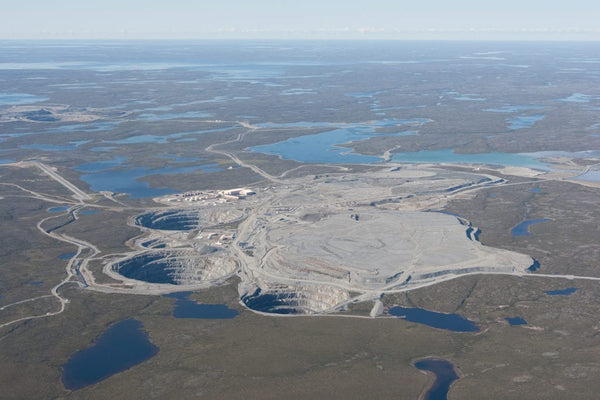
When a diamond mine is exhausted, the procedures for closing the mine are often unregulated and little infrastructure is in place to restore the ecosystem. This results in water pollution, leaving the land unsuitable for farming and susceptible to severe erosion and flooding. The remains of many diamond mines are so enormous that they can be clearly seen from space.
Open Pit and Underground Mines
Diamonds occur naturally deep inside the earth and are carried to the surface through Kimberlite Pipes. The two most common types of diamond mines are open pit and underground mines. All the sand and soil must first be removed to reach the diamond bearing rock. In some cases, this involves removing entire lakes and ecosystems. Many tons of material are removed and processed each day using large machinery and explosives, often processed using a water intensive extraction method that disrupts nearby land far beyond the pit itself.
Diamonds also accumulate in rivers and lakebeds over thousands of years as a result of sediment and erosion moving from their original Kimberlite Pipes. These operations scrape away 3.3 million cubic yards of soil and plant life per day and large walls are built to divert the natural flow of water.
The Myth of the Ethical Canadian Diamond
It is often claimed that Canadian diamonds are ethically sourced, but this is a pricey misconception labelled as sustainable. While they may not be as tarnished as blood diamonds, they are still in conflict with the environment and the communities within the mining areas.
Diamond rich areas were not discovered in Canada until the early 1990s, but within ten years, major mines were unearthed. Canada is now the third largest diamond producing country in the world. Except, any sort of mining is not sustainable. You dig a hole, you take material out, and eventually, the hole runs out.
The moral bankruptcy of the industry is illustrated clearly in Canadian diamonds. The poor environmental history of their mines, which operate in ecologically sensitive areas, speaks volumes. Independent reports from MiningWatch Canada have openly damned the industry for failures in self monitoring and mercury risks at sites like the Victor mine, which finally closed in May 2019.
Image source: National Geographic

Negative Impact on the Arctic Environment
There are many negative effects from open pit mining, especially in Northern Canada:
-
Air and Noise Pollution: Noise vibrations scare animals away. Caribou, bears, and fish lose their habitats because of the huge area these mine sites cover.
-
Habitat Loss: The environmental footprint is massive. The Ekati mine alone covered 1400 hectares of land.
-
Water Contamination: When water bodies are drained, all fish are killed. Chemicals used in processing are dangerous to water fleas, which disturbs the entire Arctic food chain.
-
Endangered Species: Radio collared cows from the Bathurst caribou herd have been shown to spend significantly less time feeding near mine sites. Population numbers have declined drastically as dust contaminates the lichen they eat.
-
Ground Level Ozone: Dust particles contribute to ground level ozone, a gas pollutant that is harmful to inhale and can damage crops and vegetation growth miles away due to wind effects.
Ekati and Diavik
A Sustainable Alternative in Newquay
The manufacturing processes involved with the creation of man made or lab grown diamonds do not require harmful pollutants or materials as open pit mining does. As technology improves, so does the quality of lab grown diamonds which can easily replace natural diamonds in terms of their hardness and variety.
At Ethica Diamonds, we believe that the definition of a conflict diamond must be redefined to include the protection of the environment. If you are looking for an engagement ring that represents true love without a trail of destruction, visit us at our boutique in Newquay, Cornwall.
We specialise in lab grown stones that offer the same beauty without the catastrophic impact on ecosystems. Whether you are in Cornwall or visiting from afar, come and speak with our team in Newquay to find a stone that aligns with your values. Let us help you create a legacy that respects the Earth as much as it celebrates your relationship.
Further reading:
A comparative look at the impact of diamonds - part 1
Read Next

Ben and Helena: The Ring in the Backpack and the Perfect Spot in New Zealand
A ring hidden in a backpack. A stranger who would not move. And a perfect spot in Pauanui, New Zealand. Ben and Helena's proposal story is one for the books.

Thomas and Ellie: A Candlelit Garden Proposal and a Ring Named After Their Daughter

